

- Mark-15 -
Offset Propeller Reduction Gearbox - NO LONGER AVAILABLE
NOTE: All our Products, Designs, and Services are SUSTAINABLE, ORGANIC, GLUTEN-FREE, CONTAIN NO GMO's, and will not upset anyone's precious FEELINGS or delicate SENSIBILITIES.
MARK-15 STATUS
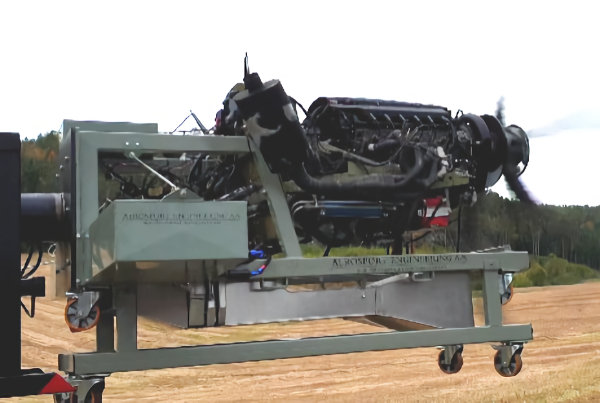
CURRENT STATUS: The recent owner (a previous EPI client)of the intellectual property and rights of the Mark-15 gearbox has sold the rights to a European company (AeroSport Engineering) and that company will be the source for Mark 15 gearboxes in the future.
HISTORY: We completed the design and analysis of the Mark-15 gearbox in 2009, and began the manufacture of the prototype system. We completed several critical components, including prototype heat-treated housing castings.
In mid-2010, EPI put the manufacturing of the M-15 prototype on "hold" in order to complete several high-priority projects, including a custom system for a leading NASCAR team and a custom system for the Chevrolet IndyCar engines.
As part of the custom V-12 engine design that we designed for a client, we designed the single-mesh version of the Mark-15 PSRU, and eventually we sold the intellectual property and all tooling and parts inventory for the Mark-15 to that V-12-engine-client. They produced a few Mark-15 gearboxes. They also provided samples to at least one well-known Reno Air Races competitor for use in a very promising clean-sheet aircraft desigh, but unfortunately that aircraft designer has passed on.
The rest of this page is meant to provide details about this excellent product so as to assist potential PSRU purchasers in making a wise and informed decision.
BACKGROUND
The Mark-15 gearbox is a lightweight, high-performance PSRU product which draws heavily on the success of the EPI Mark-9 PSRU, described by several users as "bulletproof. The Mark-15 includes our refined vibration absorption technology (now being used in NASCAR, INDY-CAR, and in military applications), improved gearing design, and new housing technology to reduce costs and increase flexibility. It can be configured to handle in excess of 1600 lb-ft. of engine torque input while retaining an acceptable margin of safety.
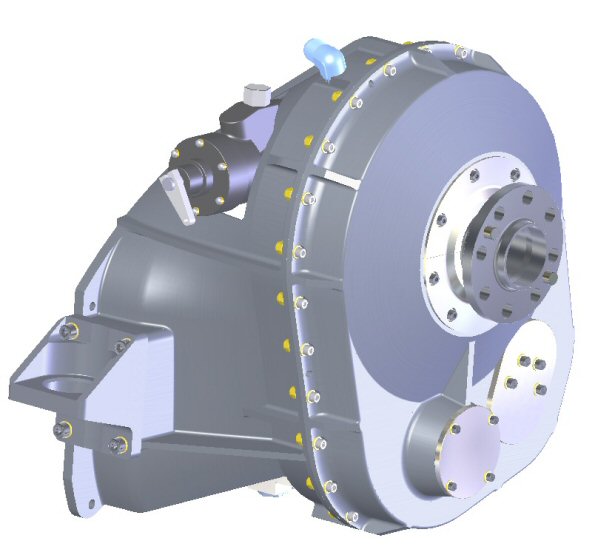
Right-Front View of Two-Mesh M-15
The technology and implementations have been proven in thousands of hours of operational experience with the Mark-9. Inspections of Mark-9 gearboxes, some having more than 500 flight hours, as well as the one that was being used in a competitive Reno Air Racer, have revealed all the internal parts to be in like-new condition.
The Mark-15 incorporates all the proven features of the Mark-9 into a less expensive housing, which is easier to machine and assemble. The two-mesh version incorporates a new design feature which cures the only known Mark-9 issue (fretting of the idler-shaft after approximately 300 hours). If you are impatient, here is a link to a summary of the Mark-15 features.
As a part of the ongoing product development and improvement program, we switched from the original Mark-15 cast, heat-treated housings to stronger billet housings, fully-CNC-machined from high-strength aluminum bricks. That development enabled us to produce both the original two-mesh configuration (prop rotates in the same direction as the engine) and a new symmetric single-mesh (prop rotates in the opposite direction as the engine) configuration. The symmetric single-mesh version was initially done to provide an optimized PSRU for our 1200-HP aircraft V-12 engine.
The vibration technology embodied in the proprietary EPI engine-to-gearbox coupling system ELIMINATES over 98% of all the torsional pulsing generated by a V8 engine, and over 99.8% of the torsional pulsing generated by an even-fire V12 engine.
For a clear insight into this vibration technology, follow these four links, in order:
PART 1, then PART 2, then PART 3, then PART 4.
MARK-15 DETAILS
The Mark-15 housing set is now a 3-piece configuration, using custom bellhousings and drive components to attach to several popular engines, including:
- Small-block and Big-block Chevy engines,
- GM LS-family ( LS-1 / LS-2 / LS-3 / LS-6 / LS-7 / LS-9 ) engines,
- Chrysler Hemi engines (both first and second generation),
- Ford Windsor and Cleveland engines,
- The Jaguar V12 engine, and, most recently,
- The BMW M-73 V12 engine.
Other interfaces can be designed and built by special request.
The housings and propshaft are designed to provide a comfortable margin of safety when exposed to the extreme gyroscopic, bending, thrust and torque loads generated by a 106-inch, 175-pound metal propeller spinning at 2000 RPM when subjected to the combined loads produced by the extreme conditions specified by 14-CFR-23.371(a)(2). (Those simultaneous operating conditions are: max thrust and max torque with 2.5 vertical g's, and aircraft rotations of 2.5-rps yaw velocity and 1.0-rps pitch velocity.)
The gears have been extensively analyzed under both static and dynamic loading conditions. As a result of the Mark-15 gear-design parameters and our proprietary vibration-absorbing technology, the Mark-15 can be equipped with gears which can handle over 1600 lb-ft of input torque with a good safety margin.
Our gear and vibration technology is so effective that the output gear for the M-15 with 800 lb-ft. of input torque capacity is only 1.0 inch wide. At 4000 RPM and 800 lb-ft. of input torque, the highest-stressed gear has a dynamic-load safety factor in excess of 1.8, and a calculated wear life in excess of 4000 hours.
Some of the other purveyors of propeller reduction gearboxes preach about the "requirement" that the PSRU must use different lubrication than the engine. One self-appointed "expert" proclaims: "Sharing engine oil with the PSRU is asking for engine and/or PSRU failure in advance." Check out our Lubrication page to see just how wrong this "expert" is. (That same "expert" also says that planetary gears can not work in a propeller gearbox. He might be interested in examining the planetary reductions in the P&W 1830, 2000, 2800 and 4360, the Wright 1820, and the Garrett TPE-331.)
EPI gearboxes use hydrodynamic fluid-film bearings (just like the crankshaft bearings in your engine) for the propeller shaft and the drive-gear. These bearings have far greater capacity than rolling-element bearings of the same size, and are much lighter and physically smaller than rolling element bearings which could carry the large loads required. In addition, the thrust-handling capacity of ball bearings (which some PSRU's use for their propshaft) is EXTREMELY limited.
We recently saw the writings of a blogger who offered the opinion that hydrodynamic bearings don't have the capacity for such an application, and that the weight of a propeller would ruin the bearings on startup. He was apparently unaware of the facts that (1) Lycoming, Continental, Franklin and others use hydrodynamic bearings exclusively in their direct drive engines, and they manage to support the weight of propellers quite nicely, and (2) hydrodynamic bearings carry far greater loads in almost every car and truck engine running today.
The EPI hydrodynamic bearing system provides CONTINUOUS thrust capability in excess of 3,000 pounds in either direction. This system has been thoroughly proven in service in the EPI Mark-9 gearbox system. (One of the aircraft entered in the 2012 Reno Air Races is equipped with a special version of the EPI Mark-9).
Our hydrodynamic shaft bearings and high-capacity thrust bearings, and therefore, the gears, are completely lubricated and cooled by engine oil. That eliminates the complexity of a separate oil supply, a separate oil cooler and the associated ductwork and cooling drag.
Hydrodynamic bearings require a continuous supply of pressurized lube oil. The oil required to support the bearings and to cool the gears is in the neighborhood of 4 gallons per minute (depending on the power being transmitted).
The Mark-15 is available in several different lengths (the distance from the engine block to the propeller flange face). The minimum length is 14.00 inches, but that can be varied within limits by means of an extended propshaft. We prefer to extend the propshaft rather than using a spacer between the propshaft and the propeller.
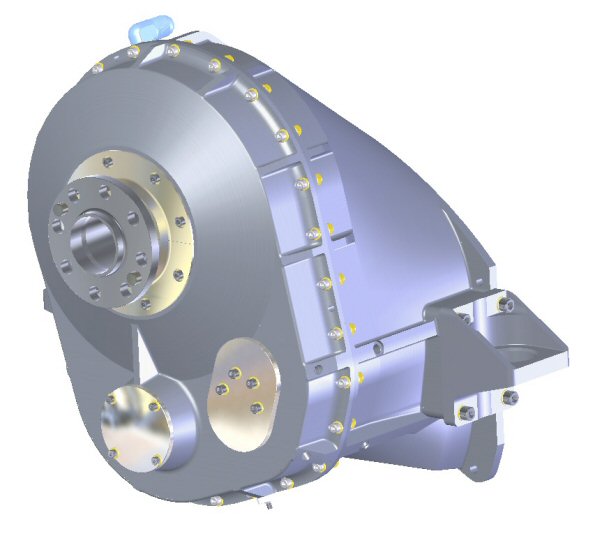
Left-Front View of Two-Mesh M-15
MARK-15 FEATURE SUMMARY
Here is a summary of the Mark-15 features:
- The Mark-15 has provisions to fit these popular engines: Smallblock and Bigblock Chevy, GM-LS, Ford Windsor, Chrysler Hemi, Jaguar-V12, Falconer V12, BMW-M-73 and other custom configurations as well.
- The vertical offset between the crankshaft centerline and the prop centerline is 7.90 inches;
- The available ratios are: 1.724, 1.821, 1.926, 2.038, 2.160, 2.292, 2.435, 2.591, 2.762, 2.950, and 3.158;
- It can provide either direction of prop rotation with either direction of engine rotation;
- The input torque capacity exceeds 1600 lb-ft. (depending on the required safety-margin);
- The propeller thrust capacity (all configurations) is 3000 lbs. in either direction (pusher or tractor applications);
- The propeller flange conforms to SAE ARP-880, which is the 8-bolt, 2-dowel configuration used on the Pratt & Whitney PT-6 and Garrett TPE-331 turbine engines, and most Continental GTSIO-520 engines;
- The minimum length from engine to prop flange is 14 inches. It is available with extended propshafts to move the propeller further away from the engine to assist with specific cowling issues;
- The integrated controllable propeller system is the common single-acting hydraulic configuration (Hartzell, McCauley, AeroComposite, MT, Hoffmann, etc.) found in most piston-engined aircraft. The propeller governor drive is integrated into the gearbox and provides an AND-20010 governor mounting pad, vibration-isolated gear-drive, and internal propeller control plumbing;
- The Mark-15 includes provisions for a reversing prop and the PT-6-style beta-feedback mechanism for the control of a reversing propeller;
- The Mark-15 uses engine oil for lubrication, cooling and propeller control, so it requires no additional heat exchangers, which helps to reduce cooling drag;
- The Mark-15 contains several gearbox "health-monitoring" features, including (i) a chip detector, (ii) two temperature sensors (for incoming and exiting oil) and (iii) an oil pressure sensor location.
- The lightest version (single-mesh) weighs 86 pounds (NOTE: weight varies with ratio, torque capacity and direction of propeller rotation).
APPLICATIONS
The 7.90 offset Mark-15 gearbox was originally designed for a cropduster application using a high-output (725 lb.-ft. torque) big-block Chevy-based engine. With the 7.90-inch vertical offset and very high torque and thrust capacities, the Mark-15 is also ideal for replica-fighter applications.
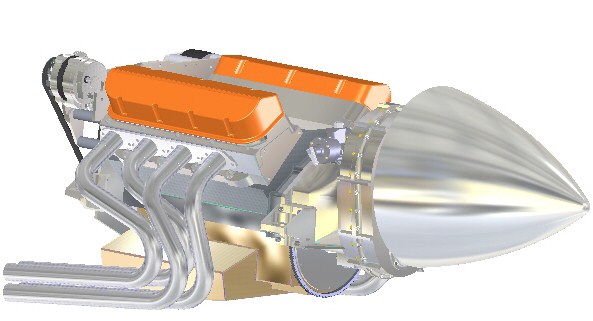
Mark-15 on the EPI Cropduster Big-Block Engine, with a 20-inch Spinner
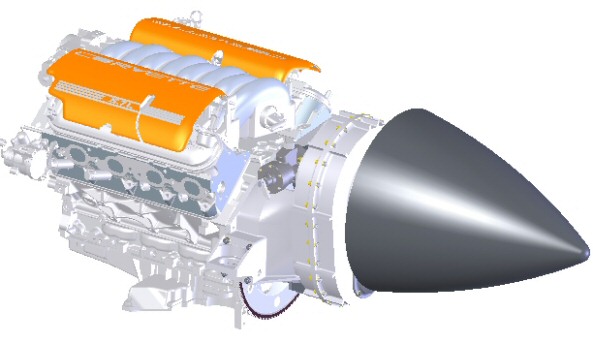
Mark-15 on an LS Engine, with an 18-inch Spinner
The Mark-15 has provisions to fit these popular engines: Smallblock and Bigblock Chevy, GM-LS, Ford Windsor, Chrysler Hemi, Jaguar-V12, Falconer V12, BMW-M-73 and other custom configurations.
The fact that the Mark-15 can be configured for either direction of prop rotation (two-mesh for same-as-crankshaft-rotation or single-mesh for opposite-of-crankshaft rotation) makes it ideal for a lightweight 500-HP V-8 conversion for a high-performance cabin-class twin-engine aircraft (Cessna 421, Pressurized Navajo, Aero-Commander 685, for example) using counter-rotating propellers for the safest engine-out performance.
THIS PAGE contains 3-view drawings of the two-mesh version of the Mark-15 gearbox, with critical dimensions. The single-mesh version has the same side view dimensions, but is smaller in the profile view from the front.
HARDWARE PICTURES and VIDEOS
The following three pictures show the raw castings for the two-piece housing set of the two-mesh M-15.
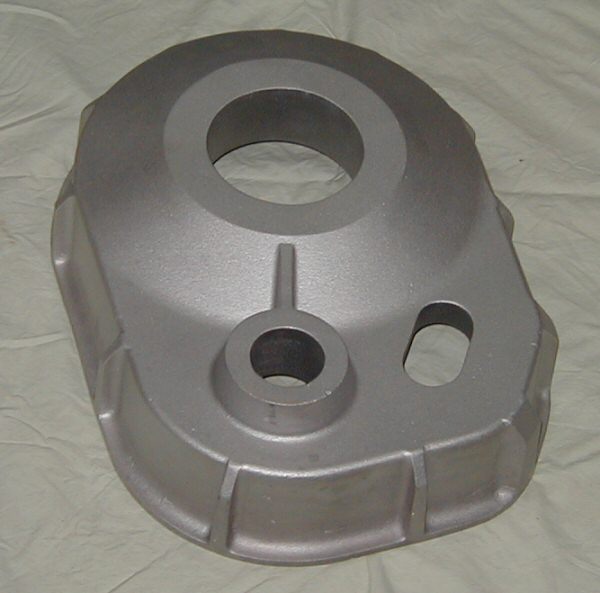
Mark-15 Front Housing Casting-Exterior
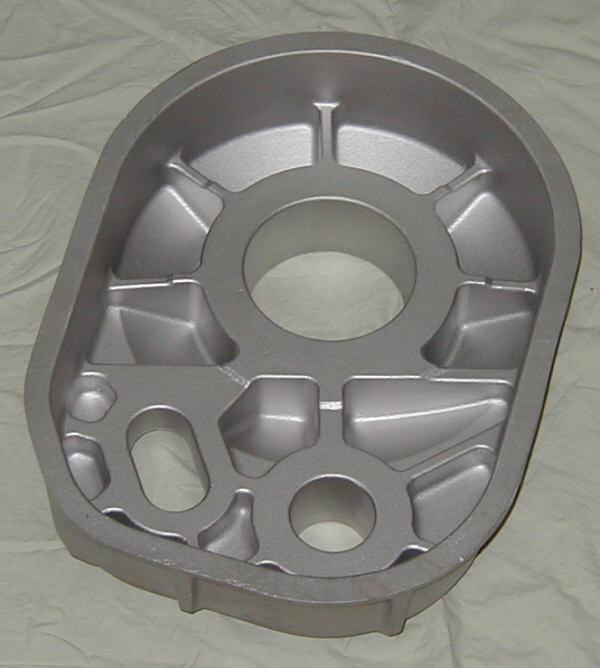
Mark-15 Front Housing Casting-Interior
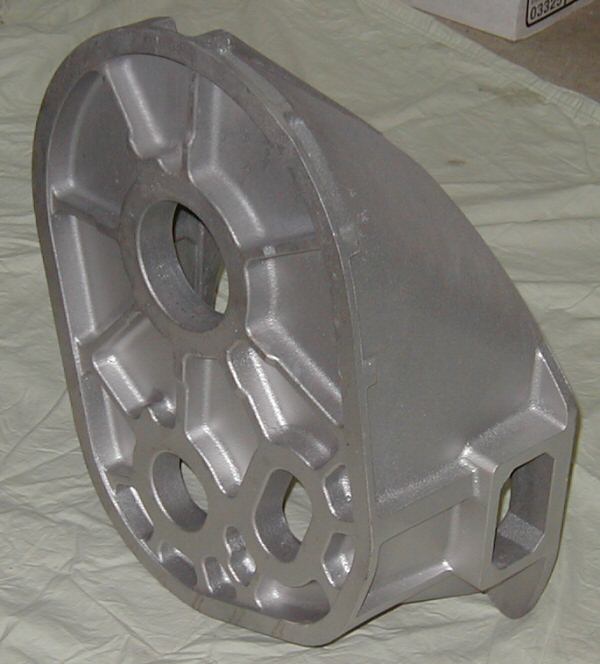
Mark-15 Rear Housing Casting (Two-Piece Housing Set)
As a part of the ongoing development process, we changed the housing set from the two-piece casting configuration to a CNC-From-Billet (6061-T6) three-piece configuration in order that the bellhousings for a variety of different engines could be made, while leaving the main gearbox set unmodified. That change also provided a significant increase in the tensile strength of the housing material.
The following pictures show the three-piece CNC housing set configured for the BMW V12 engine
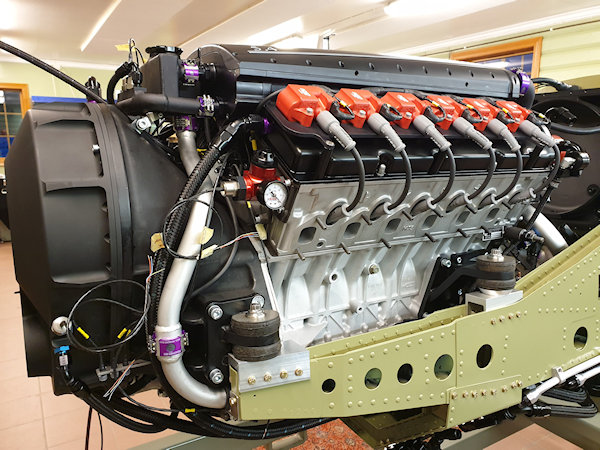
Mark-15 Single-Mesh 3-Piece Housing Set on BMW V12
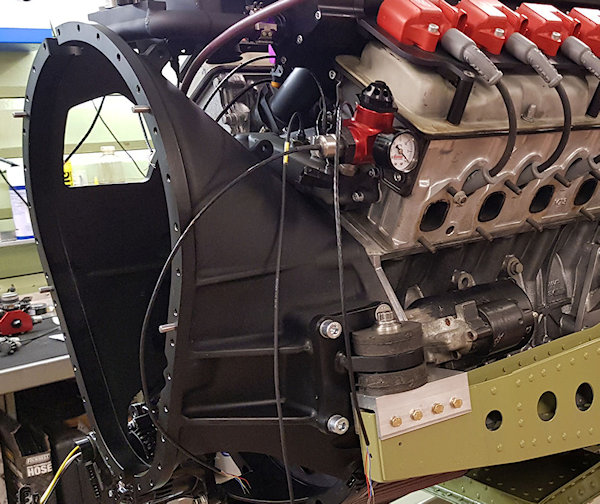
Mark-15 Single-Mesh Bellhousing for BMW V12
The next picture shows the innards of the single-mesh M-15 system.
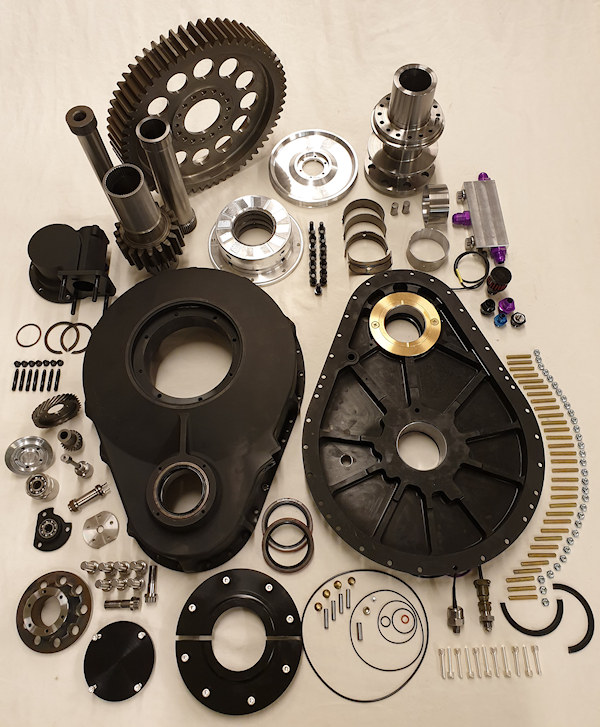
Mark-15 Single-Meash Components
CLICK HERE FOR A VIDEO showing the CNC machining of the complex Mark-15 governor drive housing from billet 6061-T6 aluminum on a state-of-the-art 5-axis mill
CLICK ON THE PICTURE BELOW for a video showing the first run of the single-mesh Mark-15 on a supercharged 650-HP BMW M73 V12.