

- 620 HP Big-Block Based Aircraft Engine -
Ideal Cropduster Engine
NOTE: All our Products, Designs, and Services are SUSTAINABLE, ORGANIC, GLUTEN-FREE, CONTAIN NO GMO's, and will not upset anyone's precious FEELINGS or delicate SENSIBILITIES.
EPI has developed a high-power, relatively low-cost GM big-block-based engine for aircraft applications in which the existing engine is very heavy (such as the Pratt & Whitney 1340 radial used in several cropduster applications). The components used by the factory in this engine are the same or similar to the components which a competent engine builder would use, but they come already assembled in a complete engine. The list of components is amazing: AQ-4340-non-twist-forged crankshaft with full counterweights, AQ-4340 H-beam connecting rods, forged aluminum (4032) pistons, excellent high-flow aluminum cylinder heads, etc.
In order to determine the suitability of a virtually unmodified engine for demanding aircraft usage, the first version of this engine was relatively unmodified and is being readied for testing in a cropduster application.
EPI developed an aircraft-suitable accessory drive system and an aircraft-suitable 18-quart wet sump oil system. The oil system can maintain oil pressure in any pitch / roll attitude up to 50 degrees away from straight and level. This configuration is shown below, with the EPI Mark-15 gearbox.
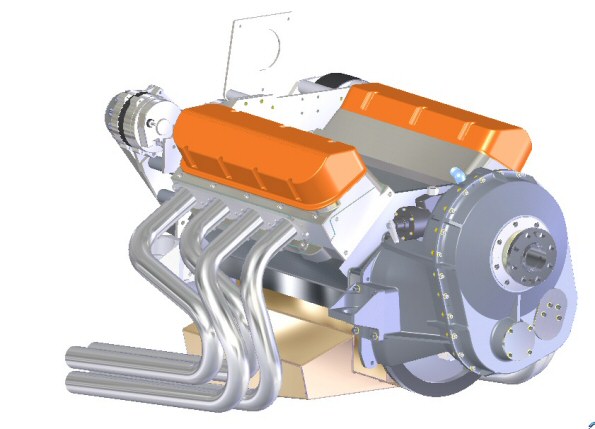
FIGURE 1: CAD Rendering of the BBC Engine with Mark-15 Gearbox
The EPI accessory drive for the Stage-1 engine is shown in the next picture. It features self-adjusting dual-serpentine drives, with both belts driving the coolant pump at the optimal speed for the required heat rejection. The coolant pump pulley features a fence between the two belts, so that if either belt fails, it will not derail the other belt, and the coolant pump will continue to be driven by the remaining belt. The alternator and air-conditioning c ompressor (it is usually HOT in cropdusting country) are driven at speeds suitable for long life.
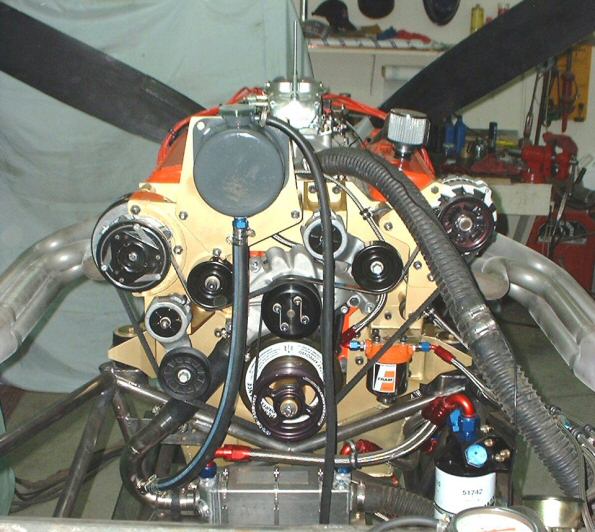
FIGURE 2: Accessory Drive System on Prototype BBC Engine
In the Stage 2 version, EPI replaced the carburetor-based fuel system with a mechanical fuel injection system, a specially-developed intake manifold, and specially developed valvetrain components to make the engine more suitable for aircraft applications. The following graph shows the power and torque for the engine in factory-delivered (blue) configuration, and the (green) Stage-1 and (red) Stage-2 EPI configurations.
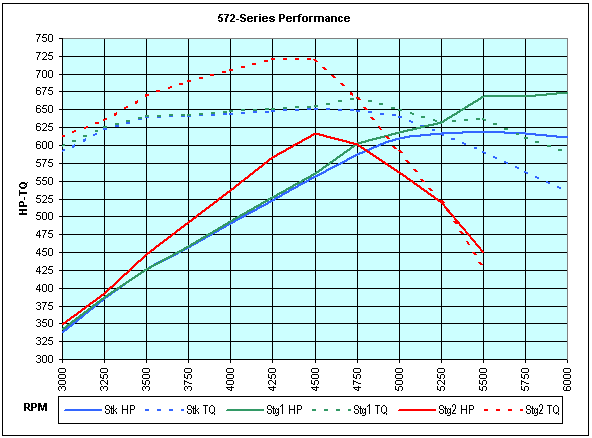
FIGURE 3: Power and Torque for OEM, EPI Stage-1, and EPI Stage-2 Engines
The blue power and torque curves show the stock engine performance, based on the factory cam profile and manifolding, which GM developed with street-vehicle usage in mind, with the preponderance of it's life spent around 2500 RPM producing less than 100 HP, and occasional full-throttle bursts to the 6000 RPM (4375 fpm mean piston speed) redline.
With the EPI Stage-1 version (green power and torque curves), we found a meaningful power increase over the factory configuration in the upper RPM range, which allows the engine to produce 620 HP at 5000 RPM (3645 fpm) for takeoff, while it makes 485 hp at a 4000 RPM cruise (2917 fpm) setting and 425 HP at a 3500 RPM cruise setting (2552 fpm). This takeoff power improvement was mainly due to (a) the EPI oil system, which substantially reduces windage losses, (b) the tailored header design, and (c) some small but significant changes in the valvetrain.
In contrast, note the shape of the (red) power and torque curves for the EPI Stage-2 engine. This version was specially developed to produce the torque curve shown, with a high, narrow peak in the cruise-to-takeoff range, while reducing the valvetrain loadings and maintaining an acceptable mean piston speed (2917) fpm at a 4000 RPM cruise with 540 HP available, and 2552 fpm at 3500 RPM with 450 HP available.
The recommended takeoff RPM for both the Stage 1 and 2 engines is 4500 RPM, for a mean piston speed of 3281 fpm. That is higher than we like to use, but in the targeted application, takeoff power is a very low percentage of the operating model, and the Stage 1 engine is a test anyhow.
If the full 620 takeoff HP is needed with a Stage-1 engine, it is available at 5000 RPM, but the MPS is fairly high at 3645 fpm. Again, it would be interesting to test this usage in service, in view of the operating model which requires full power for approximately 3 to 5 minutes of a mission, then roughly 50 to 60% of that power for the remainder of the mission.
The installation weight of this powerplant is such that it is only suitable for an aircraft which is equipped with a heavy powerplant and propeller to begin with. The complete powerplant as pictured above (with accessories and gearbox) weighs 763 pounds. Add a 160 pound propeller & spinner, a 56-pound engine mount, heat exchangers, other cooling system components, air intake system, ductwork, exhaust system, oil filter and plumbing, cowling, etc. and the entire installation weight is approaching 1250 pounds.
This site will be updated with current information on the project as it develops.